
A slab can look orderly at the saw and still require substantial work before its face is ready for a customer. Conversely, a visible sawn texture does not by itself prove poor dimensional control. Understanding the difference between a cut surface, a finishing allowance and a finished tolerance helps the sawing and polishing departments agree on what should pass between them.
Read the sawn face in more than one way
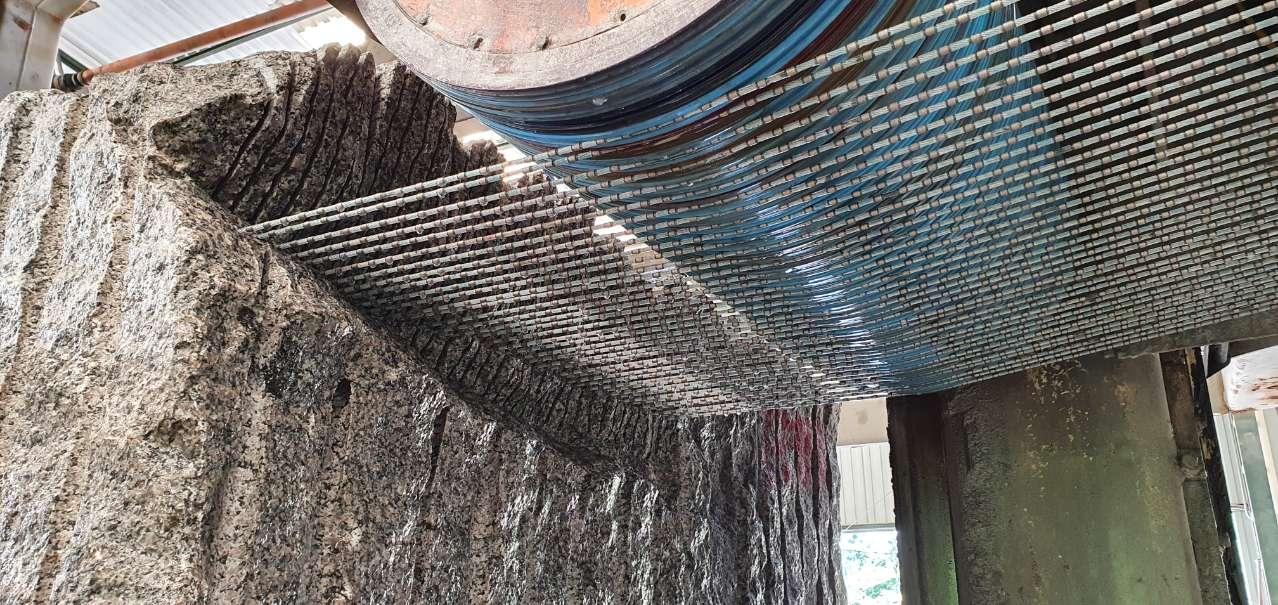
The face emerging from a multi wire saw machine carries information about texture, geometry and stone condition. These are related, but they answer different questions. Surface marks concern the condition presented to finishing. Thickness variation concerns the relationship between opposing faces. A visible vein or cavity may belong to the material itself.
Huada's thin multi wire saw cutting machine is offered for stone slicing. A purchase or production decision should evaluate the slabs it produces against the next stage's requirements, without treating the word 'precision' as a finished-surface guarantee.
A photograph may help communicate an appearance issue. It cannot replace the measurements needed to establish geometry or the agreed acceptance standard for the stone.

Allowance and tolerance do different jobs
A finishing allowance is material deliberately available for removal between the sawn state and the required finished state. A tolerance describes the permitted departure from a specified dimension or geometry. Extra allowance does not make an out-of-tolerance finished slab acceptable, and a generous tolerance is not a substitute for planning the material finishing will consume.
The allowance belongs to a particular route and product. Its adequacy depends on the incoming face, material condition, intended finish and dimensional requirement. If more than one face is to be processed, the planned removal must account for that scope rather than assuming all work occurs on the visible face.
The commercial risk runs in both directions. Too little usable stock can prevent the agreed result; unnecessary stock consumes stone and finishing resources. Neither problem is solved by adopting an unsupported universal allowance.
A surface defect is not always extra stock
A low area in a face is not material that polishing can add back. Making surrounding areas level with it consumes thickness. Whether that is commercially possible depends on the remaining geometry and the finished requirement, not merely on whether the mark can be made less visible.
Similarly, material discontinuities and surface texture should not be assigned the same remedy by default. Removing more stone may reveal further variation instead of producing the expected appearance. That is why a decision to rework needs both a dimensional assessment and a material assessment.
This distinction prevents polishing allowance from becoming a vague promise that finishing will correct every upstream problem. It is a planned material budget for a defined transformation, not an unlimited repair reserve.
Locate the removal where it actually happens
Factories often use 'polishing' as shorthand for the whole surface line, although the line can include work with different purposes. Huada's metal-bond diamond Frankfurt is described for rough grinding marble slabs, while its resin-bond Frankfurt is described for polishing marble.
Huada also lists metal-bond Fickert tools for rough slab grinding and resin Fickert tools for polishing. Those descriptions distinguish process roles; they do not establish that the tools fit every stone or installed machine.
For an allowance discussion, the important connection is the surface handed from one stage to the next. The total removal must support the finished requirement, but its distribution depends on the actual route. A catalogue of available grits is not a universal recipe for allocating that removal.

Compare the slab before and after the handover
When a finished slab disappoints, the most useful evidence often lies in the transition between departments. Connect its finished condition with the same slab's incoming geometry and face condition. Without that connection, a new scratch, an existing low area and a material feature may all be blamed on whichever department inspected last.
Huada's conventional beaded multiwire consumable is a different cutting family from its thin-wire machine. The batch history should identify the actual system used, so an observation from one route is not treated as proof about the other.
Patterns deserve examination without premature diagnosis. Similar marks appearing at the same finishing transition suggest a question for that stage; irregularities already visible on arrival point to an earlier assessment. Neither observation alone establishes a single cause.
Agree what an acceptable intermediate face means
The saw department needs a clear destination for its work. The finishing department needs an incoming condition it can convert into the ordered product. Their agreement should connect representative slabs, the intended final surface and the dimensions required after finishing.
An accepted intermediate face may still show a texture that later stages are meant to remove. Equally, a smooth-looking face may fail the geometry needed for the finished product. Separating these judgments prevents visual neatness from becoming an accidental acceptance criterion.
Reference samples can help communicate appearance, provided the parties also state what the sample represents. One attractive piece does not define every possible stone variation or prove that an entire batch has sufficient allowance.
Use finishing results to improve the next batch
Finishing feedback is valuable when it explains what the next batch needs to change in its planning. Unusually high removal, repeated rework or insufficient remaining thickness can prompt a review of incoming condition, product allocation and the agreed allowance. That review should preserve the original observations rather than reducing them to a departmental pass or fail.
The aim is a consistent connection between the stone purchased and the surface sold. Sawing should deliver material that the approved finishing route can use, while finishing should reveal whether the planned allowance was justified. Comparing planned removal with the finished result gives both departments a basis for revising the next batch's allowance and product allocation.